Lately, i have been working on some specification on Fire Extinguisher specially designed to extinguish fires resulting from deep fat. Most of our homes have kitchens and we also do frying using cooking oil. Sometimes, so much oil is used, especially deep frying, which is the favourite of malaysian cooking. Do you know that, among all the types of fires, deep fat fire is the most difficult and messy to deal with?
Why??
Most people will think that cooking oil fire is relatively easy to extinguish, judging from the tameness, less radiant heat and colour of the fire. Most people will think petrol fire is fierce. Talking about fire fierceness, i recently had the oppurtunity to witness a fire testing using methanol. For those F1 fan, i think you may know that methanol is used in F1 cars. Apparently, methanol fire is almost invisible, at first i thought the fire has been extinguihsed, but later learned that the fire is still burning.
Back to our story of cooking fire.
Theoretically, to extinguish burning cooking oil fire, we have to first prevent the oil evaporation from happening. In other words, stop the oil from boiling and releasing the oil into the air. The oil vapor, in the air, when mixed with oxygen, with the heat still around, is like the combustion of the engine, ignites and burns, then generating further heat, in return releasing more heat and oil vapour.
Let's look at how hot is burning oil.
Example: Sun Flower oil starts to smoke at 232 Deg Celcius.
This is the condition we need to start frying, right?
Then, how much heat (or rather, energy) is already being supplied into the oil?
For a typical vege oil, it's heat capacity is something like : 1.67 kJoule/kg.K.
This figure means, to heat up 1kg of vege oil, for 1 degree C, we need 1.67 kJ.
In the case, if there is 10 liter of oil, heated up until smoking condition, the heat enegy it contain, will be:
0.9 x 10 x (232 - 30) x 1.67 kJ = 3036 kJ
0.9 is applied to 10Liter, to convert into kg.
And we should remember, that water starts boiling at 100 degree Celcius.
So, using water to cool down the burning oil is out of the question.
Neither is trying to use any other method containing water, simply because, when water in in contact with the hot oil, it just boils and turns into steam, and boils violently, causing the oil to splash out everywhere violently.
Take a look at this video:
http://www.metacafe.com/watch/1082868/cooking_oil_dangerous/
How about the fire extinguisher that we normally have around us, the Powder or CO2 type?
I have personally tried using these types of extinguishers on burning cooking oil, yes, the fire is extinguished, but not long, it reignites again, something, we call, autoignition.
Reason, simply because, the powder or CO2, when applied on the surface of the fire, is effective on the fire, killing the fire, but what it cannot do, is to cool down the oil, which is still hot, so hot, that it keeps on evaporating oil into the air, mixing with oxygen in the air, and ignites, because the temperature is well above the ignition point of the oil.
Then, how do we extinguisher burning cooking oil?


11 June 2010
My Last day at the exhibition, here are some of the photos i taken:
This is how the dry powder portable fire extinguisher looks like when put in a transparent container.


This photo shows the internal construction of a Cartridge Operated Portable Fire Extinguisher, this is one of the most common design used in Germany

This is a portable manual hydraulic pressure pump, for testing any parts which requires confirmation on the strength of the parts against pressure. Parts normally tested are the container cylinder body, discharge hose, control valve, etc.

Any bikers here, how about something different for your head protection?
Oh no, this are fireman helmets.

This is how the dry powder portable fire extinguisher looks like when put in a transparent container.

This photo shows the internal construction of a Cartridge Operated Portable Fire Extinguisher, this is one of the most common design used in Germany

This is a portable manual hydraulic pressure pump, for testing any parts which requires confirmation on the strength of the parts against pressure. Parts normally tested are the container cylinder body, discharge hose, control valve, etc.

Any bikers here, how about something different for your head protection?
Oh no, this are fireman helmets.

10 June 2010


09 June 2010
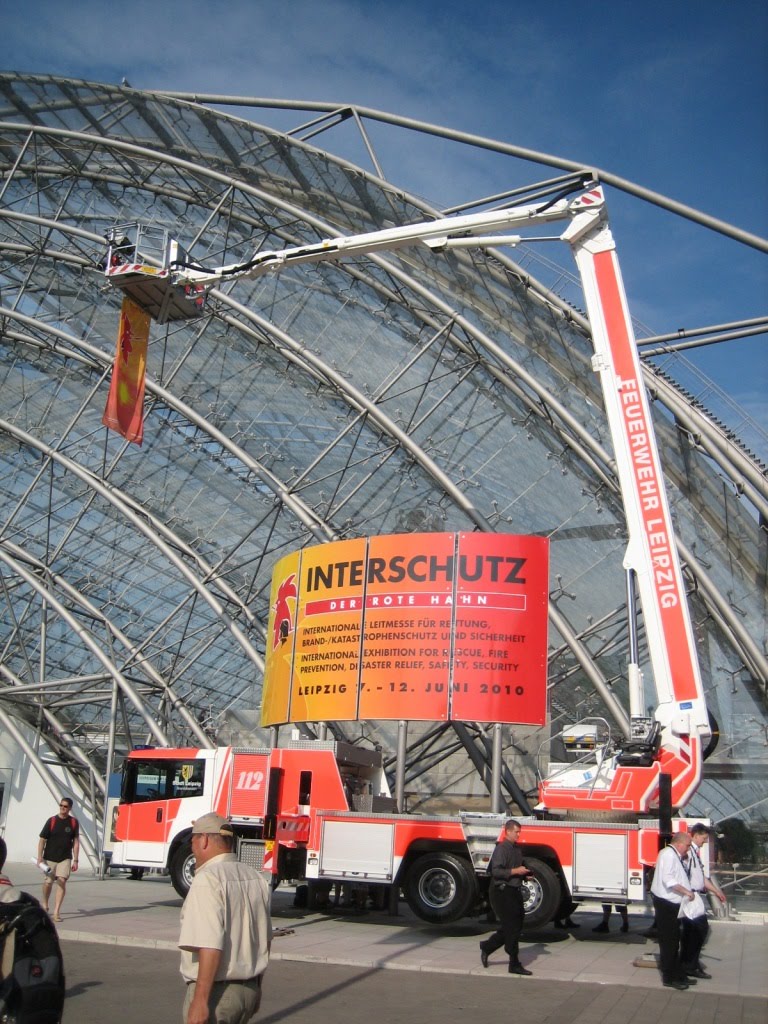
Currently i am at the Interschutz 2010, the largest International Exhibition on Fire Prevention & Fire Fighting Industries.
Foam Monitor with Pressurized Foam Tank


An antique extinguisher on display


An early fire car, i think it is a Fiat


A beauty with an early extinguisher

A remote control Monitor system, it moves like a robotic arm


My Malaysian & Singaporean friends

A rescue superbike, with an extinguisher on it, can you see where it is located?


Foam Monitor with Pressurized Foam Tank

A Malaysian Exhibitor doing preparation works

An antique extinguisher on display

A modern Cartridge operated type portable fire extinguisher on display

A military fire truck

A fire truck with pumping and hose equipment


Display on early portable fire extinguishers

A beauty with an early extinguisher


Manual Water & Foam Monitors

An Ambulance truck

My Malaysian & Singaporean friends

A rescue superbike, with an extinguisher on it, can you see where it is located?

This is the main hof, where we hae our dinner, not many choices though, but the price is reasonable.

01 February 2010
The training i mentioned in my last post was done on the 16 Jan 2010. Instead of a few colleagues, it turned out to be more than 10 of them. One of our subsidiary company staffs also joins in. It is not the numbers that worried me, but it is the fact that some of them are experienced engineers. I delivered the classroom part as per my earlier planning, but had to skip most of the slides considering the time limitation.
The practical part i asked one of my colleague to handle and it all went on well.
Most of the trainees had a chance to operate the fire extinguisher and tried to extinguish a small fire.
This photo shows a trainee trying to kill the fire.
 Alow me to comment a bit on this photo.
First, look at his foot steps, he was standing with right foot forward, and he is holding the discharge nozzle with his right hand. Usually, this is not the best way to approch a fire because it is harder to balance the weight of the extinguisher cylinder. It also appears to me that he is not fully confident, therefore he reserve his left leg at the back, prepared to make a rereat in case of uncontrolled situation.
Now, look at how he hold the discharge hose. He is holding it at the nozzle tip like holding a pencil. This method usually results in a sharper angle of discharge on the fire base, as you can see, the angle is about 45 degree. In this case, because the fuel is liquid, the powder discharge may splash the liquid fuel out of the tray and ended up on the grass, and the grass will start burning, and he will have to deal with more spots of fire. And, that was exactly what happened, but i did not record it in photo.
So, what is the problem with aiming at that angle?
No, there is nothing wrong, as long as the fire is extinguished, peacefully and quickly.
In a small fire like this one, we cannot really see the difference because there is practically a lot more powder than required to kill the fire, but if the fire gets bigger and bigger, we will need to put every gram of powder into action, to extinguisher the fire, ..... otherwise, the fire will extinguish us.
In my next post, i will try to elaborate what it means and how to put the extinguishing agent to action.
The practical part i asked one of my colleague to handle and it all went on well.
Most of the trainees had a chance to operate the fire extinguisher and tried to extinguish a small fire.
This photo shows a trainee trying to kill the fire.

First, look at his foot steps, he was standing with right foot forward, and he is holding the discharge nozzle with his right hand. Usually, this is not the best way to approch a fire because it is harder to balance the weight of the extinguisher cylinder. It also appears to me that he is not fully confident, therefore he reserve his left leg at the back, prepared to make a rereat in case of uncontrolled situation.
Now, look at how he hold the discharge hose. He is holding it at the nozzle tip like holding a pencil. This method usually results in a sharper angle of discharge on the fire base, as you can see, the angle is about 45 degree. In this case, because the fuel is liquid, the powder discharge may splash the liquid fuel out of the tray and ended up on the grass, and the grass will start burning, and he will have to deal with more spots of fire. And, that was exactly what happened, but i did not record it in photo.
So, what is the problem with aiming at that angle?
No, there is nothing wrong, as long as the fire is extinguished, peacefully and quickly.
In a small fire like this one, we cannot really see the difference because there is practically a lot more powder than required to kill the fire, but if the fire gets bigger and bigger, we will need to put every gram of powder into action, to extinguisher the fire, ..... otherwise, the fire will extinguish us.
In my next post, i will try to elaborate what it means and how to put the extinguishing agent to action.
14 January 2010
Fire Extingusher Training
Early this week, i was requested to conduct a training to a few new colleagues who have just joined my company not long ago, on basic knowledge of fire extinguishers. After some communications with this and that person, i got it arranged in the coming saturday.
It will be a 90 minutes session, of which the first 60 minutes will be a classroom lecture with a slide presentation and followed by 30 minutes of practical operating a portable fire extinguisher.
I spend some time getting the slides ready and got another colleague to prepare some extinguishers, petrol and a tray. I have not delivered such training for some time, so need to flip back my old notes to recall the key words correctly.
It will be a 90 minutes session, of which the first 60 minutes will be a classroom lecture with a slide presentation and followed by 30 minutes of practical operating a portable fire extinguisher.
I spend some time getting the slides ready and got another colleague to prepare some extinguishers, petrol and a tray. I have not delivered such training for some time, so need to flip back my old notes to recall the key words correctly.
10 December 2009
How Many Units of Fire Extinguisher to Use?
Most often this is the question i got, "How Many Units Of Fire Extinguisher Do I Need To Provide In My Office", or Factory, or whatever it is.
Let's not go into the theory first. Neither do i try to be technical.
Let's just look around. If those people out there have placed the extinguishers in their premises, and they are operating with a legal status, then they must be doing something right. Or close to right. Right??
I see most commercial shop lots, say, 30' X 80', will most likely provide 2 units of 9 kg ABC Powder Portable Fire Extinguisher. Maybe 1 unit in the front and another in the middle or back.
Then, if there is a upper floor office, i notice another unit placed near the main entrance and another unit either in the office or at the pantry or near the wash rooms.
Now, let's see what the Legal Requirement Says.
According to the Malaysian Building By-Law, the correct Malaysian Standards, or The Code Of Practice to follow, is the Malaysian Standards, MS1539 : Part 3 : 2003.
This document is the Specification For Portable Fire Extinguishers - Part 3.
Focusing on Selection And Installation - and it is a Code Of Practice, make sure you refer to the current version, which is the (First Revision), or any later version if any.
Many aspects are explained in very detail in this document.
Among others, i think will give us a simple understanding, are as the following:
a) Extinguisher Spacing
The fire extinguishers must be located such that, you can get to it without having to walk more than 20 meter.
b) Extinguisher Hanging Height
If the fire extinguisher is heavier than 4kg, (which i think most cases are) it must be hang such that the handle is about 1 meter from the floor
This is spelled out in MS1539 : Part 3 : 2003, clause 7.2
c) Calculation According To Floor Space
Since year 2002, Fire Extinguishers are approved by the Fire Brigade according to their capability to kill fire, and we are talking about how big a fire can be killed, or extinguished, if you don't prefer to kill.
Before this, not much emphasis on this "Size Of Fire Killed thing, or, technically refered to as "Fire Rating", but rather the size, in terms of kg of the fire extinguisher matters more.
The calculation goes like this : if you have a specific floor space, say, 1000 meter square.
Then, the required "Fire Rating" is calculated as, 1000 X 0.065.
So, what we get is, 65A of Fire Rating Required for that space.
Then what is 65A???
To know what this 65A means, and to translate it into number of fire extinguishers, we need to know the rating of each fire extinguisher. Now, take a look at the fire extinguisher near you, is there any?
Read the label printed on the fire extinguisher body, and you should see somehere printed the Fire Rating. Read the A rating number, maybe you will see something like, 27A/144B.
Now, assuming it is 27A. Now, the number of fire extinguisher required is : 65A / 27A
... and we should get an answer of 2.41
round it up, it comes to 3 units of Fire Extinguisher.
What i have shared here, is just some basic points, of course there are many-many more things to consider when making provision for fie safety. Anybody interested to know further, please puchase a copy of the Code from SIRIM for reference.
Let's not go into the theory first. Neither do i try to be technical.
Let's just look around. If those people out there have placed the extinguishers in their premises, and they are operating with a legal status, then they must be doing something right. Or close to right. Right??
I see most commercial shop lots, say, 30' X 80', will most likely provide 2 units of 9 kg ABC Powder Portable Fire Extinguisher. Maybe 1 unit in the front and another in the middle or back.
Then, if there is a upper floor office, i notice another unit placed near the main entrance and another unit either in the office or at the pantry or near the wash rooms.
Now, let's see what the Legal Requirement Says.
According to the Malaysian Building By-Law, the correct Malaysian Standards, or The Code Of Practice to follow, is the Malaysian Standards, MS1539 : Part 3 : 2003.
This document is the Specification For Portable Fire Extinguishers - Part 3.
Focusing on Selection And Installation - and it is a Code Of Practice, make sure you refer to the current version, which is the (First Revision), or any later version if any.
Many aspects are explained in very detail in this document.
Among others, i think will give us a simple understanding, are as the following:
a) Extinguisher Spacing
The fire extinguishers must be located such that, you can get to it without having to walk more than 20 meter.
b) Extinguisher Hanging Height
If the fire extinguisher is heavier than 4kg, (which i think most cases are) it must be hang such that the handle is about 1 meter from the floor
This is spelled out in MS1539 : Part 3 : 2003, clause 7.2
c) Calculation According To Floor Space
Since year 2002, Fire Extinguishers are approved by the Fire Brigade according to their capability to kill fire, and we are talking about how big a fire can be killed, or extinguished, if you don't prefer to kill.
Before this, not much emphasis on this "Size Of Fire Killed thing, or, technically refered to as "Fire Rating", but rather the size, in terms of kg of the fire extinguisher matters more.
The calculation goes like this : if you have a specific floor space, say, 1000 meter square.
Then, the required "Fire Rating" is calculated as, 1000 X 0.065.
So, what we get is, 65A of Fire Rating Required for that space.
Then what is 65A???
To know what this 65A means, and to translate it into number of fire extinguishers, we need to know the rating of each fire extinguisher. Now, take a look at the fire extinguisher near you, is there any?
Read the label printed on the fire extinguisher body, and you should see somehere printed the Fire Rating. Read the A rating number, maybe you will see something like, 27A/144B.
Now, assuming it is 27A. Now, the number of fire extinguisher required is : 65A / 27A
... and we should get an answer of 2.41
round it up, it comes to 3 units of Fire Extinguisher.
What i have shared here, is just some basic points, of course there are many-many more things to consider when making provision for fie safety. Anybody interested to know further, please puchase a copy of the Code from SIRIM for reference.
Subscribe to:
Posts (Atom)