10 May 2012

Fire Extinguisher Competent Person Course 2012

Recently our Fire Department Has launched a new system for Portable Fire Extinguisher Licence Application, called e-FEIS.  Previously known as H13, or just Bomba Cert.
In this new system, only competent workshop, operate by competent person, are qualified to perform the fire extinguisher servicing and apply the license on behalf of the owner.
In order to support this new system, UPM Education & Training S/B is conducting courses to train and certify existing peoples and companies in this area.  Detail information and registration forms for this course can be downloaded here Registration Form for Fire Extinguisher Competent Person Course.

20 October 2011

Hybrid Fire Extinguisher Cylinder

Last week, i met with the inventor of the maintenance free fire extinguisher, at a fire and safety exhibition in Singapore.  So, i got a closer look at the product and got first hand information from the inventor himself.  There are few things i learned:

a) the cylinder consist of 3 layers, a plastic bottle in the inside, a layer of reinforcement yarn in the middle and another plastic bottle on the outside

b) the reinforcement yarn is not rigidly binded, like the CNG Composite cylinder.
It is tightly wound around the inner plastic container.

c) the reinforcement yarn used is Kevlar from Dupont, not ordinary Glass Fibre, talking about Kevlar, maybe you should know this news.

d) 2 pressure gauges are fitted, i suppose to reduce the failure probability

e) the Valve is solid brass, Malaysia Made, i was told, so you see, Malaysia Boleh!

f) the cylinder passed crushing test.  In this test the cylinder is pressed until both walls almost touching, then inflated back to original size, and it shall nor leak

Here is a photo of the inventor (middle) with another 2 of my Singaporean friends.

I suggested to the inventor to name the cylinder as a hybrid fire extinguisher container, as it combines more than one method of fabrication.

22 September 2011

How About A Maintenance Free Fire Extinguisher ?

We have been hearing a lot about the Maintenance Free Batteries for Cars.  Are they really maintenance free? What is the definition of maintenance?  Is checking the terminals considered maintenance?

A friend of mine have designed a fire extinguisher which he claimed to be maintenance free.
The product carries a 10 year manufacturer warranty and claimed to be service free for 10 year.
The inventor also claimed it is 100% recyclable and 100% UV protected.
The best thing is, there is no corrosion risk.

I know the inventor personally, so i manage to get some reliable information on the manufacturing process of this fire extinguisher.
I cannot dispose much more information here, as i believe the design of the product is protected by law.
If you would like to know more about this product, you can logon to http://www.britannia-fire.co.uk/extinguisher-range.aspx?id=6


From the look, it is just another fire extinguisher, but after reading the literature, i start to think if this might be the turning point of fire extinguisher era.  Remember the old mini used to have a strong chromed bumper, then comes the Jap who use a moulded piece of polymer, then never before i see those shinning chromes anymore, except only on collection item cars.  I believe, this will be the envy of every fire extinguisher manufacturer in the world, to start getting panic worrying their current designs will be phased out very soon, if not immediately.

However, it is not without reservation in me.  Having some experience in polymer materials, i will predict the internal polymer (if such material is used), will somehow react in a certain way to the liquid in contact with.

I always believe nothing escapes the mother nature law of degradation, including the UV from the sun.  So, i do not buy the idea of 100% UV protected.  Well, UV stabilized sounds better to me.

Coming to the 10 year service free claim, i will agree that the foam liquid will stay intact, but how about the polymer seal used in the control valve.  As i am aware, the valve seat is compressed under tension by a spring to keep the valve closed all the time, until it is depressed to open the valve for discharge.  A rubberized material depressed for a long period of time may need some attention though.

Finally, i am very confident that this new design of Maintenance Free Fire Extinguisher, the Britania WorldFire, will change the fire industry and give a new perception to everyone towards how a fire extinguisher should be.  It will also change the behavior and practice of the servicing and maintenance personnel.  Maybe the Fire Extinguishers Standards of every country will have to be re-written, to make way for this innovation, for those who neglect will find themselves left behind.

05 September 2011

Fire Extinguisher For Moving Vehicles

Recently i was involved in a committee that writes a standard specification for fire extinguishers meant for use in moving vehicles, such as cars, buses trucks, trains, boats and ships.

Interestingly, after many years our country has developed, with so many high rise buildings, so many cars on the road, and worse of all, so many casualties of fire involving road accidents, and we are talking about drafting a code of practice for this.  Well, this does not mean we do not have standards to follow before this, it simply means there were not enough specification to take care the conditions found in moving vehicles, such as vibration, sudden impact, extreme heat, corrosion and so forth.  When it comes to sea going vessels, the first thing cross my mind is the corrosive environment, which did not present in our normal conditions, where these extreme was not tested in extinguishers not meant for sea conditions.

To give you an idea how extinguisher (which not designed for corrosive environment) will look like, if it is exposed to winds of sea, photo below was on a ferry i took sometime ago.

This photo is just an example of how a piece of nicely chromed metal can be rusted, which may compromise the strength can cause failure.  I have seen worse ones.

It is commonly seen extinguishers mounted on trucks, especially oil tankers, normally 2 pieces of 9 kg Powder Type, mounted at the back of the prime mover, or, in this case, behind the tanker.

Unfortunately, in this case, they are chained, making it not easily accesible when in need.

I once received a complaint from somebody who claimed that his fire extinguisher leaked, when i took a look, what i saw was astonishing.  The extinguisher, i suspect, was kept in the car rear boot without a good mounting bracket, so it rolled back and forth whenever the car moves or stops, causing a rubbing action which rubbed away the paint and eaten away the metal, until a puncture developed on the body.

Oops, No Photo of this case, i hope you can imagine.

Back to the committee, i hope to see the government will publish a good guide line to be followed and the regulatory bodies put them into good practice to make fire safety more accesible to everyone.

A fire extinguisher installed in a vehicle is not only for it's own use, but also can be used to rescue other vehicle on fire.  It is not always possible for the vehicle on fire to retrieve it's own extinguisher for use, for such cases, other road users' extinguisher can be used, with the help of others.

If you are interested to obtain a copy of this standard, of course, when it is released, yuo can check the availability from Malaysian Standards Online, search for MS1539 Part 7.

If you like to comment on this Draft Standard, you can check the DMS For Public Comment Site


22 May 2011

Lizards & Fire Extinguisher

Wonder if Lizards buys fire extinguishers, maybe as stand-by to protect themselves, when attacked by birds or frogs.  Ha...Ha... of course Not, Just Joking.

Yesterday, i delivered a training course to my colleagues on the topic of Fire Extinguisher Selection, Installation & Maintenance.  While going thru the inspection requirements, i recalled, once, when i was removing an extinguisher from the storage location to be inspected, i was surprised by a few lizards, who ran aimlessly out from the extinguisher box.  Probably they were rudely wake from a good nap by me.

On another occasion, i had to abandon the extinguisher and ran away.  Guess what?  There was an ant colony on the head assembly of the extinguisher.  Then, i was doing extinguisher service in an agricultural park, where most of the extinguishers were sited in the forest.

Well, enough for jokes.
In the training, i elaborated on the guidelines of the Latest Malaysian Standards, MS1539 : Part 3 & Part 4.  Part 3 talks about how to calculate the number of extinguishers required for a specific area, considering the size, what materials in it that potentially burns, etc.  The location of the extinguisher in relation to the height from floor, distance from expected user, are also defined.

Part 4, talks about the required Inspection and maintenance of the fire extinguisher.  What surprised most of my colleagues, were, the requirement of the technician who are authorized to service and maintain an extinguisher. Basically, the standards limits the job only to those who are Competent and operating from a Competent Company.

26 April 2011

Soap Making

Googled Soap Making leads to many articles describing the process, basically talks about reacting oil with strong alkaline, producing a salt, thru saponification process.

Wonder why i talk about soap making, out of a no where??

Recall my last posting, about cooking oil fire, where i described the challenges of trying to extinguish a burning cooking oil or fat??  

In this posting, i will try to explain the usual, and proven, of course also the most economical and practical, method of stopping a burning oil.  Yes, change the hot burning oil into soap! Yes, that's Saponification.  Let's SAPO the oil fire, sounds interesting, right?

The use of alkaline to turn hot oil into a fatty salt has been known by mankind for ages, maybe since few thousand years ago. Now i understand why my mom used ashes from the firewoods to clean oily utensils after cooking. It is because ashes are alkaline and it reacts with oil, turning it into salt, which can be washed away easily.

Oops, i drifted too far from what i suppose to touch, that is controlling a burning cooking oil fire.
Last saturday, i did a simple training for a friend to a group of textile factory staffs, where i showed the basic skills and knowledges of using a powder portable fire extinguisher.
It went on smoothly and i saw the trainees were more confident after the practical session, where i used a used drum with diesel fuel and water. Petrol was used to ignite initially.
After the training, we adjourned to a nearby coffee shop for lunch and the chef-cum-owner of a food stall joined us for a chit chat.  He shared his personal experience where his cooking appliance caught fire while deep frying some food stuffs.  What he did to control the fire was, to just pour in more oil into the burning oil, the fire is off. Make sense! Definitely Yes. However, this method only works when the heat contained in the burning oil is not excessively great to the extend that the cold oil is able to absorb to a level below it's flashing point. Too technical?

If the burning oil level is already close to spilling out from the container, then adding more oil will cause spillage of hot burning oil, Not A Good Thing To DO!

So, just put some alkaline in and change the oil into Soap, Fire is Out, simple?

Please do not try at home, if you are not a trained fire fighter.
If you need some training, please contact me, maybe we can share some points and do it safely.

02 April 2011

Deep Fat Fire Is Very Difficult to Extinguish! Is your kitchen safe?

Lately, i have been working on some specification on Fire Extinguisher specially designed to extinguish fires resulting from deep fat.  Most of our homes have kitchens and we also do frying using cooking oil.  Sometimes, so much oil is used, especially deep frying, which is the favourite of malaysian cooking. Do you know that, among all the types of fires, deep fat fire is the most difficult and messy to deal with?
Why??

Most people will think that cooking oil fire is relatively easy to extinguish, judging from the tameness, less radiant heat and colour of the fire.  Most people will think petrol fire is fierce.  Talking about fire fierceness, i recently had the oppurtunity to witness a fire testing using methanol.  For those F1 fan, i think you may know that methanol is used in F1 cars.  Apparently, methanol fire is almost invisible, at first i thought the fire has been extinguihsed, but later learned that the fire is still burning.

Back to our story of cooking fire.
Theoretically, to extinguish burning cooking oil fire, we have to first prevent the oil evaporation from happening.  In other words, stop the oil from boiling and releasing the oil into the air.  The oil vapor, in the air, when mixed with oxygen, with the heat still around, is like the combustion of the engine, ignites and burns, then generating further heat, in return releasing more heat and oil vapour.

Let's look at how hot is burning oil.
Example: Sun Flower oil starts to smoke at 232 Deg Celcius.
This is the condition we need to start frying, right?
Then, how much heat (or rather, energy) is already being supplied into the oil?
For a typical vege oil, it's heat capacity is something like : 1.67 kJoule/kg.K.
This figure means, to heat up 1kg of vege oil, for 1 degree C, we need 1.67 kJ.
In the case, if there is 10 liter of oil, heated up until smoking condition, the heat enegy it contain, will be:


0.9 x 10 x (232 - 30) x 1.67  kJ  =  3036 kJ


0.9 is applied to 10Liter, to convert into kg.


And we should remember, that water starts boiling at 100 degree Celcius.
So, using water to cool down the burning oil is out of the question.
Neither is trying to use any other method containing water, simply because, when water in in contact with the hot oil, it just boils and turns into steam, and boils violently, causing the oil to splash out everywhere violently.


Take a look at this video:
http://www.metacafe.com/watch/1082868/cooking_oil_dangerous/


How about the fire extinguisher that we normally have around us, the Powder or CO2 type?
I have personally tried using these types of extinguishers on burning cooking oil, yes, the fire is extinguished, but not long, it reignites again, something, we call, autoignition. 
Reason, simply because, the powder or CO2, when applied on the surface of the fire, is effective on the fire, killing the fire, but what it cannot do, is to cool down the oil, which is still hot, so hot, that it keeps on evaporating oil into the air, mixing with oxygen in the air, and ignites, because the temperature is well above the ignition point of the oil.


Then, how do we extinguisher burning cooking oil?


11 June 2010

My Last day at the exhibition, here are some of the photos i taken:


This is how the dry powder portable fire extinguisher looks like when put in a transparent container.


This photo shows the internal construction of a Cartridge Operated Portable Fire Extinguisher, this is one of the most common design used in Germany


This is a portable manual hydraulic pressure pump, for testing any parts which requires confirmation on the strength of the parts against pressure. Parts normally tested are the container cylinder body, discharge hose, control valve, etc.


Any bikers here, how about something different for your head protection?
Oh no, this are fireman helmets.

10 June 2010

More Photos of the Interchutz 2010 at Lepzig...

Steam powered fire engine

Fire Extinguishers can be very interesting...


09 June 2010

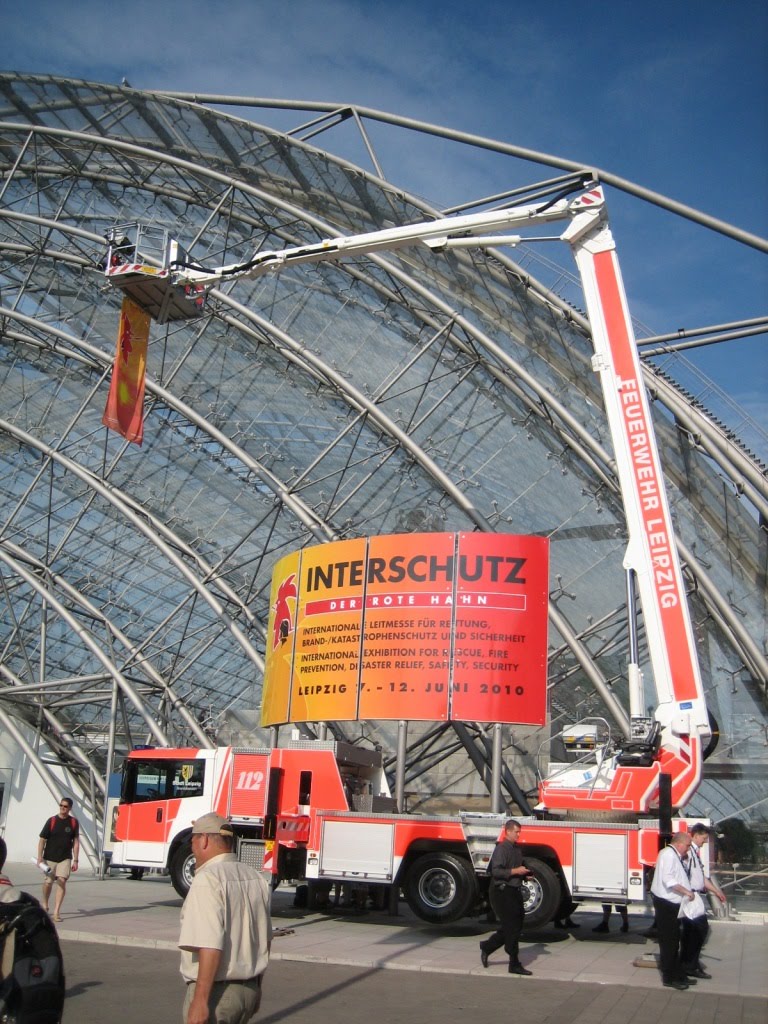
Currently i am at the Interschutz 2010, the largest International Exhibition on Fire Prevention & Fire Fighting Industries.

Foam Monitor with Pressurized Foam Tank

A Malaysian Exhibitor doing preparation works


An antique extinguisher on display


A modern Cartridge operated type portable fire extinguisher on display


A military fire truck

A fire truck with pumping and hose equipment


An early fire car, i think it is a Fiat


Display on early portable fire extinguishers


A beauty with an early extinguisher


A remote control Monitor system, it moves like a robotic arm

Manual Water & Foam Monitors

An Ambulance truck

My Malaysian & Singaporean friends


A rescue superbike, with an extinguisher on it, can you see where it is located?

This is the main hof, where we hae our dinner, not many choices though, but the price is reasonable.

01 February 2010

The training i mentioned in my last post was done on the 16 Jan 2010.  Instead of a few colleagues, it turned out to be more than 10 of them.  One of our subsidiary company staffs also joins in.  It is not the numbers that worried me, but it is the fact that some of them are experienced engineers.  I delivered the classroom part as per my earlier planning, but had to skip most of the slides considering the time limitation.
The practical part i asked one of my colleague to handle and it all went on well.

Most of the trainees had a chance to operate the fire extinguisher and tried to extinguish a small fire.
This photo shows a trainee trying to kill the fire.

Alow me to comment a bit on this photo.

First, look at his foot steps, he was standing with right foot forward, and he is holding the discharge nozzle with his right hand.  Usually, this is not the best way to approch a fire because it is harder to balance the weight of the extinguisher cylinder.  It also appears to me that he is not fully confident, therefore he reserve his left leg at the back, prepared to make a rereat in case of uncontrolled situation.

Now, look at how he hold the discharge hose.  He is holding it at the nozzle tip like holding a pencil.  This method usually results in a sharper angle of discharge on the fire base, as you can see, the angle is about 45 degree.  In this case, because the fuel is liquid, the powder discharge may splash the liquid fuel out of the tray and ended up on the grass, and the grass will start burning, and he will have to deal with more spots of fire.  And, that was exactly what happened, but i did not record it in photo.

So, what is the problem with aiming at that angle?
No, there is nothing wrong, as long as the fire is extinguished, peacefully and quickly.
In a small fire like this one, we cannot really see the difference because there is practically a lot more powder than required to kill the fire, but if the fire gets bigger and bigger, we will need to put every gram of powder into action, to extinguisher the fire, ..... otherwise, the fire will extinguish us.

In my next post, i will try to elaborate what it means and how to put the extinguishing agent to action.

14 January 2010

Fire Extingusher Training

Early this week, i was requested to conduct a training to a few new colleagues who have just joined my company not long ago, on basic knowledge of fire extinguishers.  After some communications with this and that person, i got it arranged in the coming saturday.

It will be a 90 minutes session, of which the first 60 minutes will be a classroom lecture with a slide presentation and followed by 30 minutes of practical operating a portable fire extinguisher.

I spend some time getting the slides ready and got another colleague to prepare some extinguishers, petrol and a tray.  I have not delivered such training for some time, so need to flip back my old notes to recall the key words correctly.

10 December 2009

How Many Units of Fire Extinguisher to Use?

Most often this is the question i got, "How Many Units Of Fire Extinguisher Do I Need To Provide In My Office", or Factory, or whatever it is.

Let's not go into the theory first. Neither do i try to be technical.
Let's just look around.  If those people out there have placed the extinguishers in their premises, and they are operating with a legal status, then they must be doing something right.  Or close to right.  Right??

I see most commercial shop lots, say, 30' X 80',  will most likely provide 2 units of 9 kg ABC Powder Portable Fire Extinguisher. Maybe 1 unit in the front and another in the middle or back.
Then, if there is a upper floor office, i notice another unit placed near the main entrance and another unit either in the office or at the pantry or near the wash rooms.

Now, let's see what the Legal Requirement Says.
According to the Malaysian Building By-Law, the correct Malaysian Standards, or The Code Of Practice to follow, is the Malaysian Standards, MS1539 : Part 3 : 2003.
This document is the Specification For Portable Fire Extinguishers - Part 3.
Focusing on Selection And Installation - and it is a Code Of Practice, make sure you refer to the current version, which is the (First Revision), or any later version if any.

Many aspects are explained in very detail in this document.

Among others, i think will give us a simple understanding, are as the following:

a) Extinguisher Spacing

The fire extinguishers must be located such that, you can get to it without having to walk more than 20 meter.


b) Extinguisher Hanging Height

If the fire extinguisher is heavier than 4kg, (which i think most cases are) it must be hang such that the handle is about 1 meter from the floor
This is spelled out in MS1539 : Part 3 : 2003, clause 7.2


c) Calculation According To Floor Space

Since year 2002, Fire Extinguishers are approved by the Fire Brigade according to their capability to kill fire, and we are talking about how big a fire can be killed, or extinguished, if you don't prefer to kill.

  Before this, not much emphasis on this "Size Of Fire Killed thing, or, technically refered to as "Fire Rating", but rather the size, in terms of kg of the fire extinguisher matters more.

The calculation goes like this : if you have a specific floor space, say, 1000 meter square.
Then, the required "Fire Rating" is calculated as, 1000 X 0.065.
So, what we get is, 65A of Fire Rating Required for that space.

Then what is 65A???

To know what this 65A means, and to translate it into number of fire extinguishers, we need to know the rating of each fire extinguisher.  Now, take a look at the fire extinguisher near you, is there any?
Read the label printed on the fire extinguisher body, and you should see somehere printed the Fire Rating. Read the A rating number, maybe you will see something like, 27A/144B.

Now, assuming it is 27A.  Now, the number of fire extinguisher required is : 65A / 27A
... and we should get an answer of 2.41
round it up, it comes to 3 units of Fire Extinguisher.


What i have shared here, is just some basic points, of course there are many-many more things to consider when making provision for fie safety.  Anybody interested to know further, please puchase a copy of the Code from SIRIM for reference.

11 November 2009

How To Choose A Fire Extinguisher Contractor or Supplier

Basically, a Contractor or Supplier dealing with Fire Protection Equipment Supply and/or service, shall be registered with Bomba.  The criteria for the registration are:

a) A Registered Company with ROC

Verification documents : Borang 9 : Sijil Pendaftaran Syarikat,
                                     Form 24 : Sijil Pengesahan Modal Di benar dan Modal Berbayar,
                                     Form 49 : Sijil Pengesahan Maklumat Pengarah, Pengurus dan Setiausaha Syarikat
                                     M & A : Memorandum dan Artikel Perbadanan Syarikat

b) Licenced with Local Government, eg. : Lesen Perniagaan MBSJ
c) If using e-perolehan, register with Ministry of Finance, eg.: Sijil Pendaftaran Kementrian Kewangan

If the contractor is providing service and maintenance service for fire extinguishers, then the company shall have a complete set of servicing facilities such as:

a)  powder filling machine,
b) CO2 filling machine,
c) leakage test equipment,
d) valve tightening machine,
e) clamping device and
f) any dedicated tools, as specified by manufacturers
g) appropriate waste disposal

The company shall also have competent qualified technical personnel relevant to the job, operating based on documented standard operating procedures on maintenance and servicing of portable fire extinguishers in compliance with the relevant Code of Practice, using replacement parts and procedures prescribed by hte manufacturers.

Some companies, voluntarily, get their company certified by a third party, such as SIRIM.
At the moment, this third party certification is not mandatory, but i believe later it will be mandatory by law.
This is because the Code of Practice has been gazetted by the government and published as a Malaysian Standards, back in 2004.

07 November 2009

Bomba Certificate for Fire Extinguisher

I used to get questions from my friends who wants to know how to apply for Bomba Certificate for fire extinguishers.  They were told that this certificate is required by the local town council to complete their application for business licence.  To abtain this certificate, the premise owner has to purchase Fire Extinguisher which are Certified by SIRIM, Approved by BOMBA and meets the Code of Practise, in terms of size, type and location of installation.  Application to the nearest Balai Bomba has to be made using Borang APA 1, APA 2 & APA 3. with payment.  Upon approval, normally 2 to 3 days, a certificate called H13 and a receipt is issued.  The first copy of H13 is to be paste onto the fire extinguisher body.  Make sure does not obstruct the originl label on the extinguisher body, especially the operating instructions.  The second copy is to be kept for future reference.  Sometimes the local authority requires the receipt as prove of approval, sometime they require the second copy to be submitted together with the business licence application or renewal.

31 October 2009

What SIRIM Logo means?

The Building By-Law addresses the legal requirement, TO HAVE,
while the Malaysian Standards, deals with the technical part, ie: type of extinguisher, size, performance, safety, selection, maintenance, quality assurance, etc
Malaysian Standards, are code of practice written by a committee consist of technical experts, authorities, industrialist and even representatives from the public. This document are owned by the Department of Standards Malaysia, (DSM) managed by SIRIM BHD.

The code of practice (COP) are very important documents, as they lay down criterias to be followed, for the purpose of standardization and ensure things are fit for pupose (FFP).

Our fire brigade, The BOMBA, are empowered by the minister to carry out enforcement to ensure the Building by Laws and the Code of Practices are adhered to.

BOMBA, recognized only products which are certified by Certification Bodies, such as SIRIM.

SIRIM, now being a private entity (non governmental body), is in turn monitored and regulated by the DSM.
This process is called "Accreditation".

Products certified by SIRIM, means complies to the COP, are allowed to be marked with SIRIM Logo, therefore, we say that product got SIRIM one.  I recall when i asked for a 3-pin plug, the hardware shop boss asked "you want SIRIM one, or NO SIRIM one". What he meant is whether i want a plug with SIRIM Logo (comes with a SIRIM logo sticker), or one which does not.

28 October 2009

Which Law Requires Fire Extinguisher to be equipped?

It is the Uniform Building by-Law of Malaysia which requires Fire Protection Systems to be equipped in specific places according to specific guidelines.  This book can be obtained from most Law Book Stores, including Popular Book Store.

Most people wants to know whether private homes and private vehicles needs fire extinguisher by law.
The answer is No, Not Yet, at the moment.  Maybe later the government may like to consider some minimum requirements for homes, in terms of active fire protection.

27 October 2009

Changing Fire Extinguisher Colour From Blue To Red

I started working for a fire extinguisher manufacturer since i graduated from local U, back in 1993.
Then, fire extinguishers were mainly blue in colour, of course some are black, some are red and some are pale cream in colour.  In was very interesting though, with all the different colours.  However, some will say that it is confusing, and just can't figure out which one is for what.
Then came the new regulations to unify everything to red colour, some call it fire red, some call it signal red, but the industry standard is RAL3000 red, according to the RAL colour chart.
RAL is a collection of 40 colors invented by the German Reichsausschuß für Lieferbedingungen und Gütesicherung" (State Commission for Delivery Terms and Quality Assurance) for reference.
To learn more about RAL : http://en.wikipedia.org/wiki/RAL_(color_space_system)

I was told by some industrial seniors that all extinguishers were red, before they were changed to blue (and other colours, of course).  So, we had RED, then BLUE, then RED again now.

26 October 2009

Who needs fire extinguisher and why?

History has shown that fire, although keeps life going (at least for cooking), it can also destroy, when out of control. Almost anything burns, some into charcoal, some into dust, some even leaves nothing behind.
Historically, anything that helps to put a fire under control can be called a fire extinguisher, a pail of water, a branch of leaves, a bare stick, even a blow of air from someone's mouth.  However, in modern terms, a fire extinguisher means more than that, it has to meet many-many expectations and challenges, light enough to carry, controls a large fire, can withstand tortorous conditions, cheap and good, easy to use, etc-etc.

If you have nothing around you that burns, or if it does, but does not matters you, then maybe you don't need one.  But if that is not the case, then probably you need one.  Well, you can also make your own fire extinguisher cheap and good.  Keep a pail of water handy in the kitchen or your garden is a basic thing to do.  Make sure free from mosquito baby! Keep a thick blanket near your bed, maybe can be used to cover and suffocate a bed-side flame.

24 October 2009

why i blog this?

Hi everybody. This is my first posting.
Hope my future postings can bring some benefit to the public in terms of fire prevention and fire safety awareness and knowledge.  I was and am still in the fire safety industry. I learned a lot in the past from the industry gurus, and i'd like to put them for discussion. I observed the fire safety awareness of general Malaysians are progressing but slowly, there are plenty of room for expansion.